


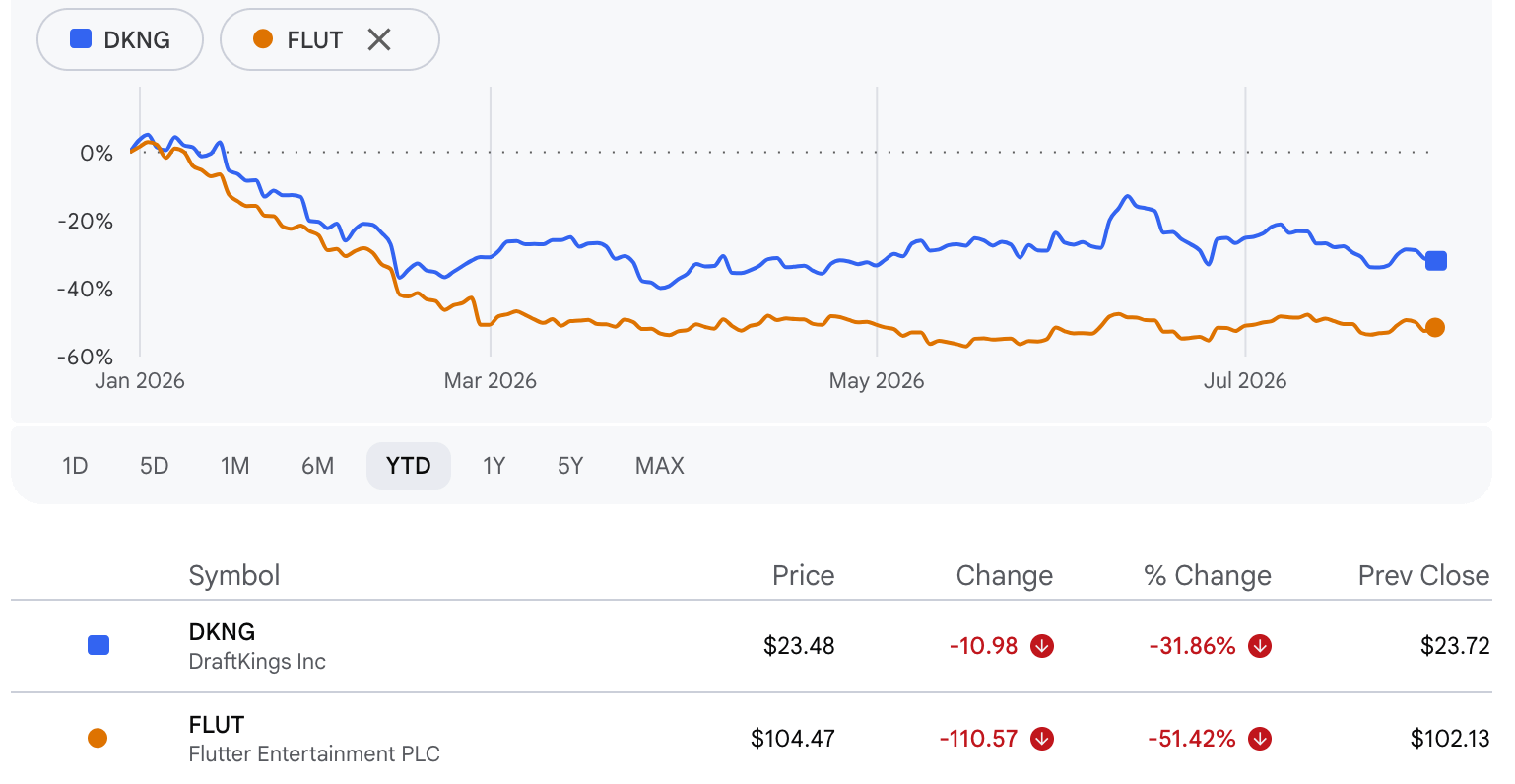
Earnings confidential: DraftKings and Flutter enter Q2 earnings with their shares down 32% and 51% respectively this year, as investors question whether the US OSB leaders can defend their patch against prediction markets. The earnings calls this week will determine if either can overcome investor skepticism and provide evidence of PM customer traction, credible market-making economics and OSB resilience.
Hard Rock Bet is growing – we know you know! And we want to bring in some more maestros to make beautiful music in our Sportsbook. You need to be among the very best in the industry to be considered for these roles. Are you up to it?
The postman always rings twice: Flutter reports Q2 earnings on Wednesday, followed by DraftKings the day after (call on Friday), and both approach their respective analyst encounters knowing the questions will extend well beyond quarterly volatility in sporting results.
DraftKings ended July with its share price at $23.48, down 32% YTD. Flutter’s fall has been steeper: its shares closed at $104.47, down 51% YTD.
Double indemnity: The declines indicate skepticism about the established operators’ growth and profitability at precisely the moment when prediction markets are emerging as both a new opportunity and a threat to their state-regulated OSB businesses.
Bank of America said the three principal investor questions ahead of the results concern FY guidance, potential prediction market cannibalization and the progress of their own predictions initiatives.
DraftKings and Flutter Entertainment YTD performance compared
Spellbound: The scale of the new competition poses quite the challenge. As E+M reported last month, Macquarie believes Kalshi could generate almost $17bn of revenue and more than $7bn of EBITDA by 2030, even with a declining PM market share.
These remain highly bullish estimates subject to significant regulatory, competitive and execution risks.
Still, they imply that a leading prediction exchange could exceed the financial scale currently expected of the incumbent sportsbooks.
The night of the hunter: Robinhood’s Q2 earnings last week provided further evidence. The company generated $156m of event-contract revenue as volumes increased more than tenfold to 13.6 billion contracts.
Rothera, its exchange JV with Susquehanna, processed more than 3.5 billion contracts within weeks of launching.
Cboe CEO Craig Donohue said on Friday of the company’s event-contract plans that it was “building something we believe will define the next chapter of growth.”
“There is demand for simple outcome-based ways to engage with markets that have traditionally felt out of reach for many investors,” he added.
See the Earnings Extra edition to be sent later today for more on Cboe’s comments.
The fallen idol: Immediate earnings expectations appear more demanding for DraftKings. JPMorgan forecasts Q2 adj. EBITDA of $120m, compared with the $188m Street estimate. BofA is also at $120m and has reduced its FY26 estimate from $700m to $625m, while Deutsche Bank forecasts $140m of quarterly adj. EBITDA, down from its previous $246m.
DB reduced its sportsbook net revenue estimate to $884m from $968m and its iCasino forecast to $446m from $469m.
The team estimates DraftKings’ same-store sportsbook handle was down ~2% YoY through the available May data, while QTD iCasino GGR was growing by only 1.9%.
Whether DraftKings maintains its $700m-$900m FY EBITDA guidance will therefore be closely watched.
DB believes the low end remains achievable but said this depends heavily upon Q4 performance and an assumed structural hold rate of ~12%.
Murder by contract: Predictions investment adds another complication. DraftKings previously indicated that it expected to spend $200m-$300m this year. BofA believes expenditure could come in slightly above the company’s ~$250m working assumption.
Investors will want evidence that DKeX is attracting customers and liquidity, alongside details of the product roadmap ahead of the NFL season.
DraftKings must also explain how it intends to scale market making without accepting excessive reserve requirements, trading risk or exposure to sharper customers.
All through the night: Flutter’s consolidated position looks more resilient. JPMorgan expects group adj. EBITDA of $482m, only 1% below the $488m Street estimate cited in its preview. But the greater uncertainty concerns FanDuel.
BofA forecasts $110m of Q2 EBITDA, against its $113m consensus figure, but its $634m FY estimate remains well below Flutter’s $970m guidance midpoint.
The analysts said FanDuel’s sportsbook handle share had begun to stabilize, although accelerating prediction market activity made them hesitant to assume a material second-half recovery.
Murder is my beat: The company will be expected to explain how FanDuel Predicts performed during the World Cup, what product improvements are planned before the NFL season and when the new operation’s economics might offset any cannibalization in regulated OSB states.
Its market-making capabilities will be particularly important.
Building consumer volume without sufficient liquidity could restrict growth; providing that liquidity internally introduces capital requirements and the risk of being on the wrong side of heavily traded events.
To have and have not: Standing still is hardly an option, but competing aggressively carries its own cost. DraftKings and FanDuel must invest in product, marketing and liquidity while potentially accepting narrower exchange-style take rates than their sportsbooks generate.
The upside is their brands, existing customer bases, tech and trading expertise could help them gain share, particularly once the NFL season begins.
Predictions can also extend their reach into states without regulated OSB.
Body and soul: The counterargument is that this expansion may transfer existing OSB customers into a lower-margin product while forcing both companies to spend heavily against better-established exchange operators.
This week’s earnings should establish whether the underlying businesses remain on course.
But restoring investor confidence will require something harder: demonstrating that DraftKings and FanDuel can become serious prediction market operators without sacrificing the earnings story investors originally bought.
Go deeper with E+M PRO: Earlier this morning, we sent out our Week Ahead edition to PRO subscribers looking ahead to the Q2 earnings from DraftKings and Flutter alongside Wynn and Penn Entertainment. Upgrade to E+M PRO.

Increase Operator Margins with EDGE Boost Today!
EDGE Boost is the first dedicated bank account for bettors.
Increase Cash Access: On/Offline with $250k/day debit limits
No Integration or Costs: Compatible today with all operators via VISA debit rails
Incremental Non-Gaming Revenue: Up to 1% operator rebate on transactions
Lower Costs: Increase debit throughput to reduce costs against ACH/Wallets
Eliminate Chargebacks and Disputes
Eliminate Debit Declines
Built-in Responsible Gaming tools
To learn more, contact Matthew Cullen, chief strategy officer: Matthew@edgemarkets.io
+More
Betfred’s shop drop
Hostile environment: Betfred is to close 132 betting shops and shed around 600 jobs as the bookmaker responds to what chief executive Joanne Whittaker called an increasingly hostile “fiscal and regulatory environment.”
The closures amount to roughly 10% of Betfred’s retail estate and will leave the Warrington-based operator with ~1,100 shops, down from a peak of ~1,680.
Whittaker blamed higher employer national insurance contributions, wage inflation, increased taxes and wider economic uncertainty.
“We have tried hard to protect all our sites and the colleagues who work in them,” she said.
Same business, different taxes: The Treasury told The Times that it rejected the suggestion that government policy was responsible, pointing out that duties applying directly to betting shops have not increased.
But that distinction might be lost on many: remote gaming duty has risen from 21% to 40%, while a new 25% OSB duty takes effect in April next year.
Industry PR consultant Tony Kenny, said on LinkedIn that “sadly, this could be a sign of what’s still to come for the retail betting sector as every last penny is squeezed out of operators.”
Arcade fire: Betfred may have an alternative use in mind for some locations. NEXT.io reported the operator is exploring entry into the adult gaming center (AGC) sector, potentially including the conversion of existing betting shops into slot arcades.
No decisions have reportedly been made about individual properties, although the report suggested Betfred is understood to have acquired a small AGC business of up to seven venues to obtain the necessary licenses.
Yet AGCs are hardly a tax-free refuge: the sector is confronting proposals to double machine games duty to 40%.
Go Mets: Novig has become the New York Mets’ exclusive prediction market partner in the first such agreement involving a MLB franchise. The multi-year deal includes Citi Field signage, broadcast branding and digital activations.
Macau scorecard: Casino GGR fell 8.4% YoY to MOP20.26bn ($2.51bn) in July, but improved 9.4% from June, beating forecasts. The decline reflected World Cup-related pressure early in the month. But in a note on MGM Resorts last week, Truist said that post-tournament July revenues had seen a “very significant recovery.”
Markets
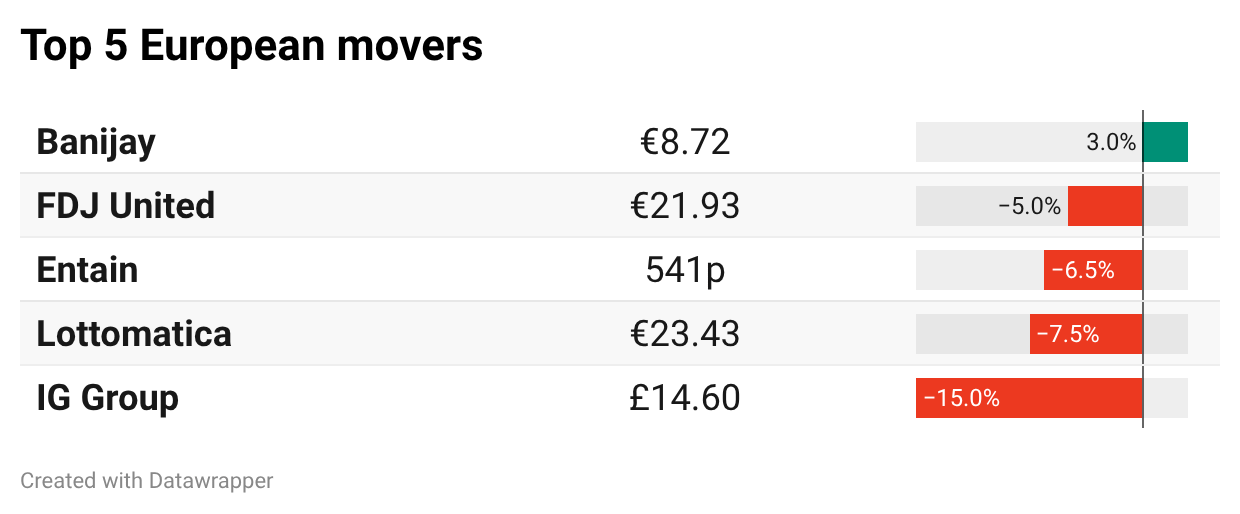
Down in the dumps: IG was the biggest faller of the European listed operators, down 15%, after agreeing to acquire Underdog for up to $1.3bn. Company enthusiasm for prediction markets met investor worries about price, execution risk, equity issuance and suspension of IG’s buyback, and came off worse.
FDJ United fell 5% as its H1 numbers exposed continued weakness across the former Kindred operations.
Entain dropped 6.5% amid continuing concern over its response to higher UK gambling taxes. News of ~500 job losses reinforced the scale of the cost pressure, with the tax changes expected to add ~£200m to annual expenses.
Lottomatica lost 7.5% despite strong online growth.
Roar of approval: Banijay was the week’s sole riser, gaining 3% after first-half revenue increased 16.9% to €2.58bn and adj. EBITDA rose 18.5% to €503m.
It was the company’s decision to rule out a Lionsgate bid and prioritize debt reduction that reassured investors.

OpticOdds is now the first sportsbook API available inside Claude.
Your trading team can now query live odds, fixtures, player props, market data and more - all in a single sentence.
Setup takes two minutes. If you want to see it in action, get in touch at opticodds.com/contact
Puts+takes
The song remains the same: BetMGM’s reliance on iCasino provides protection from prediction markets, but its best product remains trapped behind America’s regulatory walls.
iCasino “is the answer,” declared the team at CBRE last week following BetMGM’s Q2 earnings.
The problem is that few US states are prepared to ask the question.
iCasino generated ~68% of BetMGM’s Q2 revenue and grew 7.6% YoY to $483m. By contrast, OSB revenue edged up just 0.2% to $228m as higher promotional spending consumed the benefit of improved hold.
That mix makes BetMGM less exposed than sports-led rivals to the advance of prediction markets.
It estimates the new competition is already having a low-single-digit impact on sportsbook handle while the greater pressure is coming through increased media costs and customer-acquisition expenses.
Slow going: BetMGM has responded by refusing to chase every player. Active users fell 6% during H1, but handle and revenue per active rose 18% and 17%, respectively, reflecting its concentration on higher-value customers.
The difficulty is that BetMGM’s strongest defense is also its largest strategic constraint.
It is dependent upon a slow expansion process over which it has little control. The company last week identified Virginia, Washington DC and Indiana as the most promising legislative prospects.
Yet, the CBRE team described the pace of progress as “tepid.”
Prediction markets increasingly occupy the political attention that might otherwise have been devoted to online casino regulation.
Bottom feeders: In the meantime, slowing top-line momentum is becoming more visible. BetMGM maintained its FY26 revenue and adj. EBITDA guidance of $2.9bn-$3.1bn and $300m-$350m, respectively, but now expects to finish towards the bottom of both ranges.
CBRE also reduced its FY27 EBITDA forecast to $424m from $435m, while the team’s $500m annual target is now likely to slip beyond FY27.
So, yes, iCasino may be the answer. But until more state legislators permit it, BetMGM must produce much of its growth through efficiency, margin expansion and better monetization of existing customers.
The product with the greatest potential remains the one with the fewest places to go.
Upcoming earnings
Aug 3: Sportradar
Aug 4: Brightstar, Accel, Red Rock, Wynn Resorts
Aug 5: Flutter Entertainment, Light & Wonder, ZEAL Networks
Aug 6: Penn Entertainment, DraftKings (earnings)
Aug 7: DraftKings (call), Century Casinos

Octoplay has officially launched in Alberta on the first day of the province’s regulated iGaming market opening, going live simultaneously with BetMGM, FanDuel, DraftKings, Betty, Rush Street Interactive, PENN, and bet365. 🇨🇦
An +More Media publication.
For sponsorship inquiries email scott@andmore.media.

the $120m vs $188m ebitda gap is the headline, but the more interesting data point is what's sitting beneath it. the june 9 8-K (i track these on wiseek) showed annualized consumer prediction volume up 24% month-over-month in may, with total volume traded up 34%. that's the actual pm traction signal the street is debating. the osb miss looks bad on its face, but the filing trail suggests the predictions ramp is moving faster than the quarterly number lets on.