


Analyst says Kalshi’s ‘taker’ volumes could be over $500bn in four years’ time.
In +More predictions: Robinhood in talks with Crypto.com for predictions tie up.
Buyback and better: Betplay’s DigiPlus intervention bears fruit.
Betting Hero says much predictions growth is coming from traditional betting.
Hard Rock Bet is growing – we know you know! And we want to bring in some more maestros to make beautiful music in our Sportsbook. You need to be among the very best in the industry to be considered for these roles. Are you up to it?
Monster

You’ll be banging on my chest, bang-bang, gorilla: Kalshi is on course to be generating revenues of close to $17bn and an EBITDA of $7bn by 2030, if it maintains a share of only 35% of a market that the team at Macquarie believes could be worth up to $1.5trn in ‘taker’ volume.
Look what you’ve done: Macquarie’s estimates are based on their own assessment of taker volume. Every prediction market transaction involves a maker supplying liquidity and a taker accepting it.
Headline notional volume therefore counts both sides, while Kalshi derives most of its revenue from taker fees.
Feel good Inc: Using this measure, the bullish estimate from the analysts is that Kalshi’s own volume will balloon from $92.7bn this year to $520bn by 2030, with marketwide taker volume rising at the same time from $169bn to $1.49trn.
Conservatively, the analysts suggest Kalshi’s market share will fall from 55% to 35% by 2030.
Assuming a take rate of 3.35%, Macquarie then estimates Kalshi’s revenue rising from just over $3bn this year to $16.9bn by 2030.
Suggesting EBITDA margins will go from minus 9% to plus 43% over the same period, the team estimates the company will be generating $7.23bn in EBITDA by 2030.
By way of comparison, Bank of America’s mid-point estimates for DraftKings sees the company generating revenue of $6.49bn in 2026 and EBITDA of $621m
Bankroll got bigger: Investors in Kalshi have been bidding up the market leader’s value, with reports suggesting a forthcoming funding round will see its valuation reach $40bn.
However, the figures being spoken about by Macquarie suggest that even this huge valuation could soon be eclipsed.
Still, Kalshi’s eventual value will be “determined less by near-term funding rounds and more by its ability to sustain liquidity leadership, expand trading activity, and become the dominant infrastructure provider within a rapidly growing prediction market ecosystem.”
Both sides now: Macquarie’s forecast would also indicate a fundamental change in the composition of the business. Sports represented an estimated 88% of Kalshi’s 2025 volume, but Macquarie expects that contribution to fall to 47% by 2030.
Sports taker volume would still reach almost $247bn, but non-sports activity would grow faster to ~$274bn.
That would make Kalshi less a sportsbook in financial clothing and more a general purpose event exchange covering politics, economics, financial markets and weather.
“We expect the business to become increasingly diversified,” Macquarie said. “We believe prediction markets are evolving into a new asset class at the intersection of exchanges, sports betting and retail trading.”
Going back to Cali: There are naturally some large caveats. Among them is the nature of where prediction markets and Kalshi are having the most success, which at present is thought to be in the non-OSB states of California and Texas.
The Macquarie team said they believe the majority of Kalshi’s current volume is being driven by the roughly 40% of the US population that does not have access to legal OSB.
This is corroborated by a recent report from EKG, which suggests California and Texas contribute 44% of Kalshi’s volume while non-OSB states total 69%.
“The key question that remains unanswered is how durable this demand will be if and when major states such as Texas and California legalize OSB,” commented Macquarie.
Temporary relief: The related caveat is regulatory. Prediction markets currently face a lower tax burden than state-regulated sportsbooks, but Macquarie expects governments eventually to seek a larger share through taxes, licensing fees or revenue-sharing requirements.
“We do not think today’s regulatory framework will persist indefinitely,” the team warned.
Still, that may only hold a small degree of comfort for the regulated gaming sector.
Macquarie estimates suggest that even with declining market share, higher taxation and intensifying competition, Kalshi could develop into a business of extraordinary scale.
+More predictions
Heated rivalry: Robinhood is discussing a deal to offer Crypto.com’s prediction contracts through its own platform, potentially intensifying its emerging rivalry with Kalshi. According to the The Wall Street Journal, an agreement would give Robinhood retail users access to yes-or-no contracts supplied by Crypto.com’s exchange.
Robinhood currently sources markets from Kalshi, Interactive Brokers’ ForecastEx and Rothera, its exchange venture with Susquehanna.
However, Robinhood’s share of Kalshi trading volume has fallen since Rothera launched, underlining a shift from distribution partner to competitor.
Crypto.com, meanwhile, launched its OG prediction platform earlier this year and has separately agreed an integration with Truth Social, although that product remains unreleased.
Tarek Mansour, Kalshi CEO, previously told the WSJ that Robinhood was a partner but “at the same time they’re competing with us, and I think that’s also great.”

Octoplay has officially launched in Alberta on the first day of the province’s regulated iGaming market opening, going live simultaneously with BetMGM, FanDuel, DraftKings, Betty, Rush Street Interactive, PENN, and bet365. 🇨🇦
The week ahead
BetMGM: Last time out, the company cut its 2026 revenue outlook to $2.9bn-$3.1bn and expected adj. EBITDA to be toward the bottom of its retained $300m-$350m range. The question now is whether BetMGM can still reach $500m of EBITDA in 2027 without a meaningful iCasino reacceleration. BetMGM report tomorrow.
Caesars Entertainment: Caesars enters Q2 with its future apparently settled after agreeing Fertitta Entertainment’s $31-a-share, $17.6bn take-private, including assumed debt. The results still matter, but with no analyst call the numbers will have to do the talking. Caesars also reports tomorrow.
MGM Resorts: Similarly, the operational questions surrounding MGM Resorts’ Las Vegas operations will be overshadowed by Barry Diller’s $18bn takeover proposal. MGM Resorts reports on Wednesday.
Robinhood: Prediction markets are increasingly central to both the anticipated earnings beat and its long-term valuation, with the analysts looking for whether Rothera can internalize that activity, improve the economics and sustain growth through football season. Robinhood also reports on Wednesday.
Plus, Churchill Downs, Rush Street Interactive, Codere Online and Lottomatica; all in this morning’s Week Ahead edition (PRO subs only).
DigiPlus Intervention
Listen up: DigiPlus renewed its share-buyback program days after an unusual public intervention from the Juroszek family’s investment foundations.
But Tomasz Juroszek told Earnings+More that authorization alone is not enough: the Philippine operator must demonstrate it intends to use it.
Time to take action: DigiPlus has allocated PHP5.36bn ($87m) to a program allowing it to repurchase up to 10% of its outstanding shares over 12 months. The decision followed a July 6 open letter from Betplay Capital Foundation, ZJ Foundation and MJ Foundation.
They collectively own ~1.4% of the company and described a substantial buyback as “the single most value-accretive action available.”
Juroszek, whose family founded Polish betting market leader STS, nevertheless remains cautious. “I’m not sure yet” whether the matter has been resolved, he said.
“They authorized 10% of the shares to be bought back. But from what I’ve seen they haven’t executed anything. So, I don’t know whether it’s only the announcement or whether they’ll take further action.”
Let me in on the plan: DigiPlus used less than half of its previous 10% authorization before it expired. The company has responded directly to the foundations and invited them to discuss their proposals.
“I’d prefer it if they bought back even more, but 10% is still quite significant,” Juroszek said. “I’m trying to understand whether there’s a genuine plan behind it.”
Cash argument: Betplay’s case rests on the gulf between DigiPlus’s cash generation and its valuation. Its letter estimated the company was trading at ~2.4x forecast 2026 EBITDA and 0.4x sales, with a free-cash-flow yield of around 32%.
Applying peer-group median multiples would imply a value of PHP30 a share, more than 150% above the price when the letter appeared.
With more than PHP20bn in cash and virtually no debt, the foundations argued that uncommitted spending on land-based expansion should be deferred.
Juroszek believes DigiPlus can make those investments gradually while preserving the associated tax benefits.
“The best use of capital right now is to buy back the shares,” he said. “Once they finish the land-based investment, maybe in two years, there may not be the same opportunity in the share price.”
Valuation play: The family first invested around three years ago, attracted by the newly legalized online market, migration from retail gaming and DigiPlus’s established brand.
It reduced its exposure at higher prices before rebuilding after restrictions, including the removal of direct links between e-wallets and licensed gaming apps, helped drive a sell-off.
“Initially, it was cheap because it was growing a lot; now it’s cheap as a very good value play, producing a lot of cash,” Juroszek said.
Active, not activist: The public letter was a departure for a family that generally advises management privately. “We don’t consider ourselves activist investors,” Juroszek said.
DigiPlus was “one of the first times” it had intervened publicly, because management’s apparent support for buybacks was not sufficiently aligned with the board, controlling owners and other shareholders.
The family has taken a more direct role at Gentoo Media and GiG Software, where it is respectively the largest and second-largest shareholder.
Juroszek remains convinced by the 2024 separation of the former Gaming Innovation Group, arguing that the media and platform operations possessed few natural synergies.
Both companies’ valuations remain depressed, although Gentoo is still growing and highly cash-generative, while GiG Software is approaching profitability.

OpticOdds is now the first sportsbook API available inside Claude.
Your trading team can now query live odds, fixtures, player props, market data and more - all in a single sentence.
Setup takes two minutes. If you want to see it in action, get in touch at opticodds.com/contact
Predictions research
I’m a substitute for another guy: Prediction markets may be attracting new users, but early evidence suggests much of their growth is coming at the expense of traditional sportsbooks rather than expanding the overall wagering market.
Research from player-insights specialist Betting Hero found that seven of 11 recent prediction market users had funded their activity wholly or partly by diverting money previously allocated to sportsbooks.
Only three described their prediction market expenditure as genuinely new spending.
The survey respondents are from Betting Hero’s panel of sportsbook-first users who bet at least weekly
Eat y’self fitter: The findings present both a warning and an incentive for established betting operators considering an entry into prediction markets. Offering event contracts may help them defend their share of customers’ wallets.
But the product could also cannibalize their higher-margin sportsbook businesses.
Small numbers: Prediction markets currently account for only a small proportion of player spending. Across the survey’s 32 respondents, an average of ~7% of monthly wagering budgets went to prediction markets, compared with 48% for OSB and 37% for iCasino or slots.
However, usage is moving upwards. Six of the 11 prediction market customers said they were spending more than three months previously, while only one had reduced expenditure.
Looking ahead, four expected their activity to increase further during the following three months and none anticipated cutting back.
A different type of betting: Kalshi was the most commonly used platform, selected by nine respondents, followed by Polymarket with six. Sports outcomes were the only prediction-market category used by all 11 customers, with negligible activity in politics, entertainment or financial markets.
Latency: Betting Hero also found considerable latent demand among the 21 respondents who had not recently used a prediction market.
Eleven said they would shift between 10% and 25% of their sportsbook wagering if prediction platforms offered every sport on which they currently bet.
Promotions appear to offer the clearest route to conversion.
I believe in you: Prediction market operators are also leaving an opening in retention. Nine of the 11 users had received no personalized outreach during the previous 30 days, while none rated their prediction market VIP or host experience more highly than that provided by their main sportsbook.
“What this research tells us is that prediction markets aren’t unlocking new wallets; they’re competing for the same dollar the sportsbooks already own,” said Isaac Plotsker from Betting Hero.
“And when you’re fighting for the same money, the experience becomes the differentiator,” he added.
Currently, he said there was a “glaring gap.”
“We’re already seeing the beginning stages of loyalty programs from prediction markets, but right now even the best of them might not stack up against the worst from a top-5 sportsbook.”
Markets
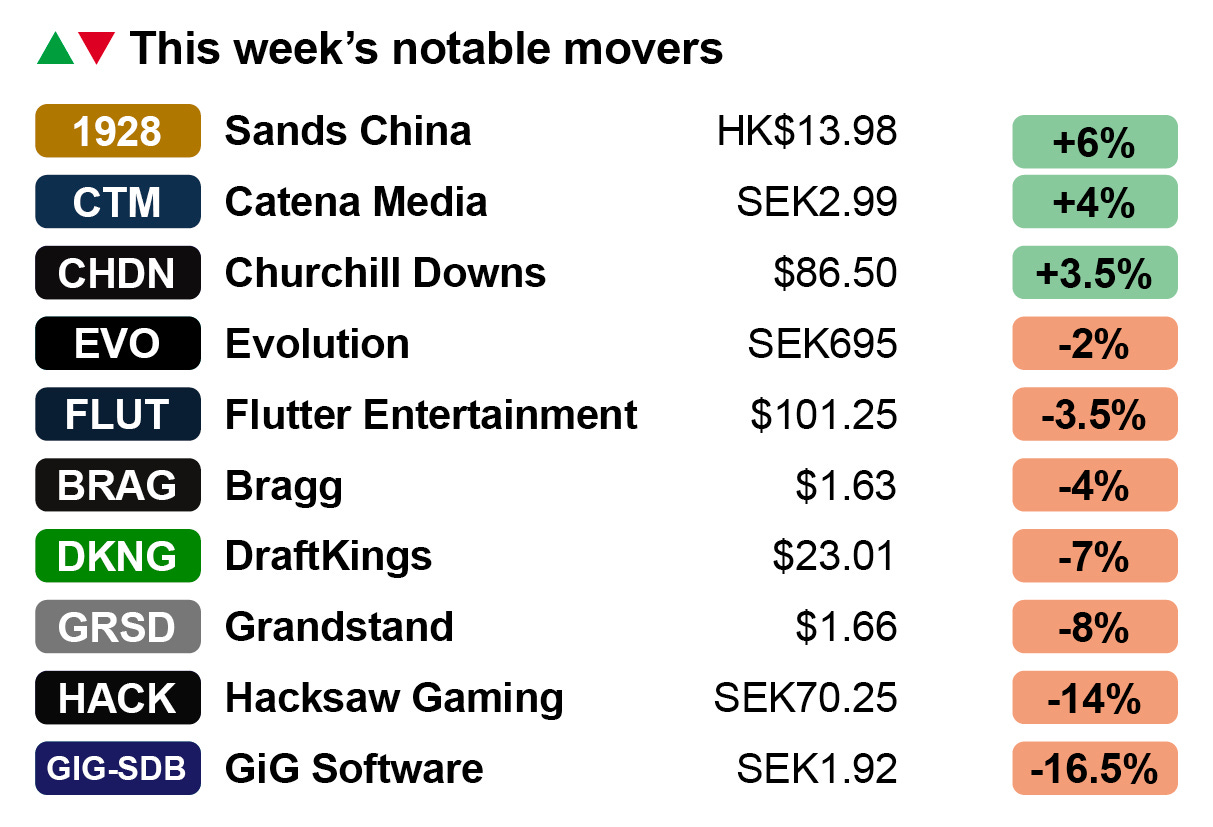
What we’re reading
Prediction markets are minting a new type of insider trader, via Bloomberg. A TikToker took a stop watch to the stadium in San Francisco where Super Bowl LX was taking place and timed how long each version of the National Anthem took at rehearsals. “Then he used that data to bet more than $50,000 on Polymarket that the anthem’s length would be under 117 seconds on game day – and scored a massive win when it turned out to be 104.”
Upcoming earnings
Jul 28: Caesars Entertainment, BetMGM
Jul 29: MGM Resorts, Robinhood, VICI (e), Rush Street, Churchill Downs (e)
Jul 30: Lottomatica, CIRSA, Codere Online, VICI (call), Churchill Downs (call)
Jul 31: Gaming & Leisure Properties

Does your Bet Builder supplier or in-house Same Game Multi solution support 12 sports, including all of the main global betting sports, plus local variants and even eSports? Does your product allow your end-users to place both Pre-Match and In:Play Bet Builders across multiple sports? Can you offer cashout across all Bet Builder transactions? Does your solution use your own odds rather than another opinion of the market? If the answer to any of these is ‘no’ then come and find out why over 200 operators are using the Algosport Bet Builder solution today.
An +More Media publication.
For sponsorship inquiries email scott@andmore.media.
