

The middle men
Market making is emerging as prediction markets’ major profit pool

Jump Trading the latest to suggest prediction markets are driving a trading boom.
In +More: Underdog launches predictions under its own steam.
The week ahead: Las Vegas Sands, Kambi and Boyd all report.
Markets: Investors welcome news of Entain job cuts.
Hard Rock Bet is growing – we know you know! And we want to bring in some more maestros to make beautiful music in our Sportsbook. You need to be among the very best in the industry to be considered for these roles. Are you up to it?
Make it wit chu

You wanna know if I know why: The volume already flowing through prediction markets has created a potentially material new earnings stream for sportsbook operators, proprietary trading firms and trading infrastructure providers.
Jefferies estimates market making could generate $340m of annualized EBITDA for Flutter Entertainment at June volumes.
Bank of America sees $200m–$300m+ of revenue for DraftKings by 2027-28.
Meanwhile, Bloomberg reported last week that Jump Trading has doubled its prediction markets team to about 20 people and plans further hiring.
I can’t say that I do: Market making has rapidly moved from being part of the plumbing of prediction markets to a potentially significant earner for sportsbooks and an increasingly important new business for financial trading firms.
Jefferies said Flutter reported “positive early indicators” in May from market-making activity on a major third-party prediction platform.
The analysts estimated Kalshi’s $58bn annualized parlay volume that month could represent a $160m revenue and $140m EBITDA opportunity for Flutter.
By June, Kalshi’s annualized parlay volume had more than doubled to $143bn as the World Cup accelerated activity.
On that run-rate, Jefferies increased the potential market making opportunity to $340m of EBITDA.
Don’t understand the evil eye or how one becomes two: The comparison with Flutter’s existing expectations is striking. Its FY26 US EBITDA guidance stands at $970m, while Jefferies said guidance and consensus estimates include ~$300m of prediction market investment and no associated revenue.
Market making could therefore cushion the second quarter and increase confidence in H2 guidance.
Meanwhile, it would demonstrate that prediction markets can be incremental to Flutter rather than merely cannibalizing its sportsbook, Jefferies suggested.
And I just can’t recall what started it all: Bank of America sees a similar opportunity for DraftKings. It believes market making could add $200m-$300m of revenue in 2027-28, based on parlays reaching 30% of prediction market volume and generating a 15% hold.
The numbers could become “substantially larger” if the parlay mix approaches that seen in OSB or DraftKings starts making markets on third-party exchanges, such as Kalshi.
However, concentrated liabilities around particular teams, players or events could produce significant volatility, while market making at scale may require substantial collateral even if that capital is tied up only briefly.
Those risks could leave the business attracting a lower valuation multiple than the higher-margin fee income earned by an exchange.
Or how to begin in the end: Evidence of the institutional opportunity is also emerging outside the sportsbook sector. The news of Jump Trading’s predictions expansion comes after the high-frequency trading firm began trading on Kalshi and Polymarket late last year.
It has arrangements to receive small stakes in both platforms in return for providing liquidity.
Simon Johansen, Jump’s head of prediction markets, told Bloomberg that Super Bowl volume was 10 times higher this year than in 2025 and suggested another tenfold increase could follow in 2027.
“The way that we’re building the business is that we want to be able to trade anything and everything where there’s opportunity,” he said.
Susquehanna has similarly been talking up its market-making prowess and this month put up $500m for hedging economic risk during the World Cup.
I ain’t here to break it: For Dean Sisun, CEO at ProphetX, sportsbook operators are equally natural candidates to become dominant sports market makers. “I have always thought FanDuel and DraftKings could become the Citadel of sports,” he told E+M last week.
“They have an enormous amount of sports data that nobody else has and have been trading it for years, close to a decade,” he said.
“If you are good at market making, it is a high-volume, low-margin play and a huge potential business stream,” he added. Market making is a “major opportunity for them.”
Just see how far it will bend: Enda Kendrick, founder of exchange and prediction markets infrastructure specialist Veltium, similarly regards institutional liquidity as essential. “You and I are not going to post $10m or $20m of liquidity on the Philadelphia Eagles at the weekend,” he said.
“These markets need institutional market makers. That creates an extraordinary opportunity for market-making businesses.”
Sometimes the same is different: Yet Kendrick’s experience of the UK exchange sector also points to how the economics of prediction markets could evolve. Market makers prosper while exchanges continue attracting recreational liquidity.
But mostly it’s the same: Over time, however, the strongest trading groups begin competing against one another and platforms seek a larger share of their profits.
“If you do not own the platform, you are at the mercy of the platform operator and the way it chooses to extract revenue,” Kendrick said.
“Platforms may take a relatively small cut today, but if they see market makers earning very large profits they will eventually seek a bigger share.”
Notable trading names from the existing exchange ecosystem, such as Tony Bloom’s Starlizard and Mathew Benham’s Smartodds, are already very active in prediction markets.
These mysteries of life: Market making remains the big unknown. In principle, its TAM is determined by the amount customers lose across the ecosystem and how those losses are divided between platforms and market makers. But in practice, limited disclosure makes that split impossible to establish precisely.
“The whole topic is so vague that we are all scrambling around trying to make assumptions,” said one informed predictions and exchange source who requested anonymity. “There is just such a lack of information.”
Competition, fee structures and potential conflicts between operators’ B2C businesses and their market-making divisions will all determine how the TAM is divided up.
Strategies developed on betting exchanges will not necessarily transfer directly to prediction markets.
That just ain’t my thing: Capital is another open question. Sources suggested the introduction of margin should reduce the need for institutions to collateralize the full potential exposure from parlays.
Even without it, they noted that full collateralization did not prevent market making from developing on Betfair.
If I told you that I knew: Seni Thomas, CEO of EDGE Markets, has already encountered the scale of the funding requirement. He said EDGE introduced one large operator to a debt fund because it needed to raise $350m to make markets for its own combination product.
“Capital is becoming fragmented across liquidity pools,” he said. That fragmentation will increase as multiple exchanges list near-fungible contracts with different prices and liquidity.
Thomas said market-making groups organized as LLCs or trading shops face banking friction, AML-related account closures and markets operating outside conventional banking hours.
Removing those constraints could help prediction market volume significantly exceed the widely cited forecast of $1tn annually by 2030. “If we do our jobs properly, the figure could be closer to $5tn or $6tn,” Thomas suggested.
“What most projections do not factor in is the exponential increase in trading volume that can occur if you remove the frictions around cross-venue liquidity.”
About the sun and the moon: For now, the projections remain preliminary. But Jump’s recruitment drive, Susquehanna’s efforts, including the Rothera JV with Robinhood, and the plans being developed by Flutter and DraftKings suggest the opportunity will not belong solely to the exchanges attracting consumers.
A parallel contest is already under way among sportsbook trading teams, proprietary market makers and the infrastructure providers responsible for keeping their capital moving.

Increase Operator Margins with EDGE Boost Today!
EDGE Boost is the first dedicated bank account for bettors.
Increase Cash Access: On/Offline with $250k/day debit limits
No Integration or Costs: Compatible today with all operators via VISA debit rails
Incremental Non-Gaming Revenue: Up to 1% operator rebate on transactions
Lower Costs: Increase debit throughput to reduce costs against ACH/Wallets
Eliminate Chargebacks and Disputes
Eliminate Debit Declines
Built-in Responsible Gaming tools
To learn more, contact Matthew Cullen, chief strategy officer: Matthew@edgemarkets.io
+More
You’re on your own: Underdog has launched its own federally licensed prediction market exchange within its existing app, expanding beyond its previous intermediary partnerships with Crypto.com and Kalshi. The company acquired a DCM and DCO in March and is also registered as a FCM, giving it what it described as the first complete prediction market licensing stack held by a sports company. CEO Jeremy Levine said the exchange would broaden Underdog’s offering across sports, culture and other event markets.
Compliance+More
Non! France’s gambling regulator has ordered the country’s ISPs to block Polymarket, branding the prediction market platform an illegal gambling and betting offering. The ANJ said the site would remain inaccessible while noncompliant with French rules, citing risks of significant player losses and potential manipulation, including suspected use of inside information on weather wagers. Polymarket did not comment.
The week ahead
Las Vegas Sands enters Q2 with its two markets telling different stories. Marina Bay Sands remains the group’s earnings engine, although a hold-assisted prior-year comp and normal seasonality may temper the headline numbers. But Macau remains problematic given evidence of a marketwide QoQ slowdown.
Kambi’s record World Cup provides striking evidence of the product and AI advances CEO Werner Becher outlined after Q1. More than 100 million Turnkey Sportsbook bets were placed before the final, with Bet Builder and player-prop growth supporting a strong margin.
Boyd Gaming enters Q2 with its regional casinos performing strongly but its Las Vegas operations facing continued destination softness. Cadence Crossing, online gaming and Sky River should provide support.
See today’s The Week Ahead edition (E+M PRO subs only).
E+M PRO
Evolution: The Q2 recovery was broad but incomplete: Europe returned to sequential growth, RNG achieved double-digit expansion and the Americas reached record revenue, yet another step backwards in Asia left the group below last year. See Friday’s Earnings Extra (PRO subs only).

Octoplay has officially launched in Alberta on the first day of the province's regulated iGaming market opening, going live simultaneously with BetMGM, FanDuel, DraftKings, Betty, Rush Street Interactive, PENN, and bet365. 🇨🇦
Markets
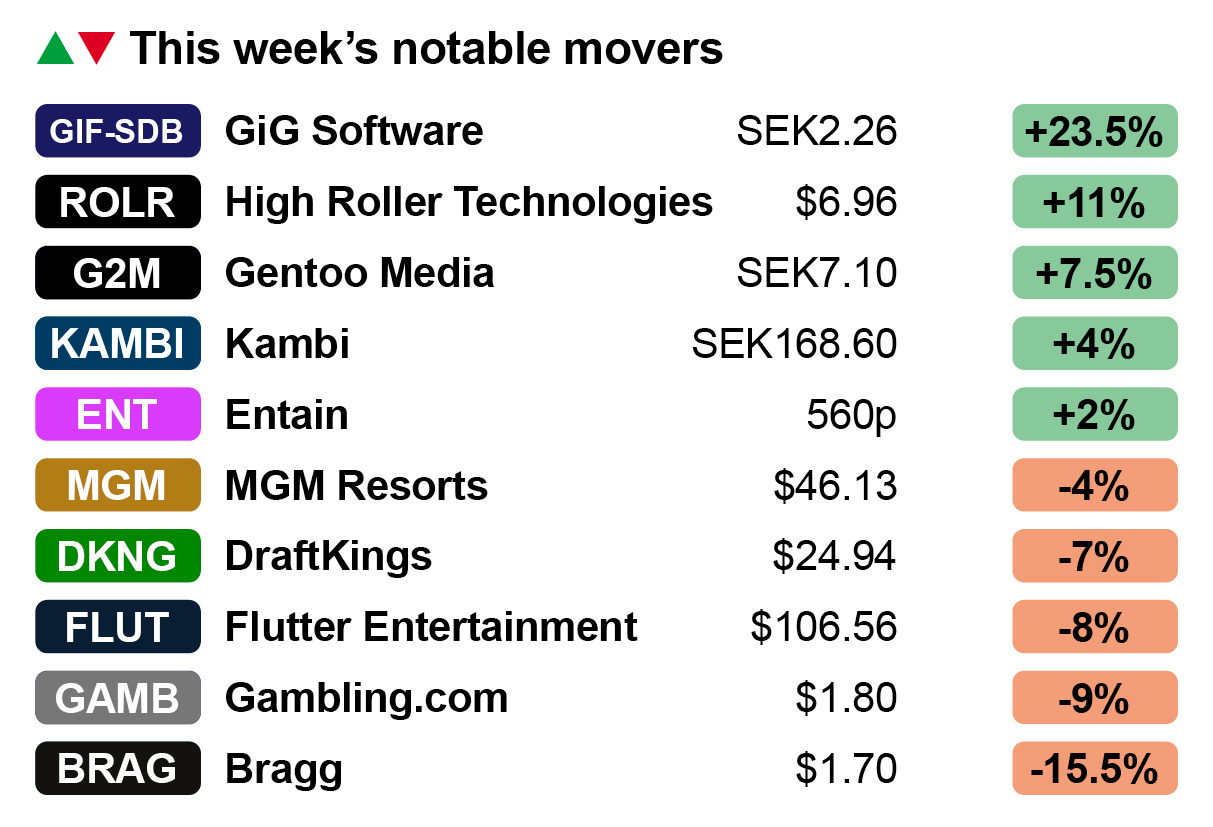
Cutting crew: Entain notched a 2% gain after the company confirmed late last week that it will cut 500 roles, around 2% of its workforce, as it seeks to counter higher UK online gambling taxes and growing prediction market competition.
The company expects tax changes to add about £200m to annual costs and said group-wide savings should offset more than half.
Down draft: The ongoing news of soaring prediction market volumes continues to rattle investors in the US OSB market leaders, with both DraftKings (down 7%) and Flutter Entertainment, home of FanDuel, (off by 8%) in the doldrums this week.
A note on Friday from Jefferies made the point that early adoption of DraftKings Predictions product has “likely resulted in a pull-forward of marketing” in Q2 and into Q3.
Combined with punter-friendly NBA finals and World Cup group stage results, it means the team are expecting a more-than halving of YoY adj. EBITDA down to an estimated $141.6m.
“Our view remains that the company’s ability to rapidly monetize its Predictions investment is the most important catalyst for share upside through the balance of the year,” Jefferies added.
Waiting on a change: The Jefferies team also remained positive on another casualty from the past week, Gambling.com, which continued its YTD losing streak, down a further 9%.
But the Jefferies team remained positive, suggesting the risk/reward is “skewed to the upside” given a new product launch in the coming weeks and emerging opportunities in prediction markets.
“That said, we expect these initiatives to build gradually, and while the long-term outcomes are likely positive, investors will need to remain patient as the benefits materialize,” they added.
Gig working: GiG Software enjoyed a rare good week, up 23.5% ahead of the news this morning that it has had its CoreX offering certified for Spain. The company also launched in Alberta last week via its LuckyDays clients and an additional launch for a new brand in Ontario.
What we’re reading
Polymarket’s corporate structure is a mystery – even to some of its former employees, in Wired. “One of the biggest oddities about Polymarket has remained somewhat overlooked: What’s going on with the Panama-based company it set up to comply with a settlement it made with the federal government? And why, as Wired’s reporting suggests, do some employees of the Panamanian company appear to have worked from New York?”
Sports gambling ETF: “You give the sports ETF your money, and the ETF uses your money to make 40 to 80 sports bets… If it wins those bets, it uses the winnings to make more bets and you make money. If it loses the bets, you lose money. It is an ETF for making sports bets. It will trade on the stock exchange, you can buy it from your stockbroker, and it will make sports bets.” Matt Levine from Bloomberg on the potential for a sports-betting ETF.
A gambling disorder played a significant part in the death of a sales manager who took his own life in 2021, a coroner has ruled, in The Times. “A lack of intervention by the gambling company William Hill also contributed to Gareth Evans’s death, the HM assistant coroner Adela Williams concluded at his inquest at Croydon coroner’s court on Thursday.”
Upcoming earnings
Jul 21: Hacksaw Gaming
Jul 22: Kambi, Las Vegas Sands
Jul 23: Boyd Gaming

Does your Bet Builder supplier or in-house Same Game Multi solution support 12 sports, including all of the main global betting sports, plus local variants and even eSports? Does your product allow your end-users to place both Pre-Match and In:Play Bet Builders across multiple sports? Can you offer cashout across all Bet Builder transactions? Does your solution use your own odds rather than another opinion of the market? If the answer to any of these is ‘no’ then come and find out why over 200 operators are using the Algosport Bet Builder solution today.
An +More Media publication.
For sponsorship inquiries email scott@andmore.media.
