


Affiliate wonderland: Prediction market economics are yet to be fully worked out, but the billions of dollars flowing through the trading volumes is starting to show up in the figures from the large betting and gaming affiliates with player acquisition spending on the rise. But the higher prices being paid for access to premium sports audiences means marketing into the coming NFL season could be more expensive for the OSB operators.
Hard Rock Bet is growing – we know you know! And we want to bring in some more maestros to make beautiful music in our Sportsbook. You need to be among the very best in the industry to be considered for these roles. Are you up to it?
Floorfillers

I bet you look good on the dancefloor: Better Collective, Grandstand and Genius Sports all used their Q2 earnings calls to describe how prediction market operators are now buying traffic, advertising and data from businesses that previously served mainly sportsbooks.
The already visible effect on affiliate revenue and media pricing could intensify if sportsbooks respond by increasing their own marketing expenditure.
Asked whether sportsbooks and prediction markets were competing for the same customers, Genius CEO Mark Locke said: “The short answer is yes.”
“There is a battle and clearly that’s causing the premium space to be elevated in price.”
That’s the way I like it: That battle is more important for affiliates than determining whether prediction markets ultimately complement or cannibalize OSB wagering because they can supply customers and services to both sides.
Better Collective said on Friday that North American CPA revenue increased 50% to €5m during Q2, “primarily driven” by prediction markets.
The €5m represents all North American CPA revenue rather than prediction market income alone, but the analysts at Redeye said the category was the principal driver of the increase.
You make me feel: Prediction markets also contributed to a 24% rise in Better Collective’s new depositing customers to 373,000, mostly generating CPA income rather than longer-term revenue share. “The strong NDC development within the category therefore translates into an immediate revenue contribution,” co-CEO Jesper Søgaard told the analysts on the Q2 call.
He noted that Better Collective began 2026 with only one active prediction market partner, adding another during Q2.
“In terms of pricing and competition, not the most ideal scenario, having just one player,” Søgaard said. “Now we are seeing another being active. We expect more to come.”
Asked about prediction market CPAs, Søgaard said prices were increasing and should contribute to a better H2 performance.
“It’s not just a direct impact from prediction markets, it also spills over to our sports-betting customers in their behavior,” Søgaard said. “A highly competitive environment is exactly what drives prices.”
Anything you want done, baby: When Grandstand presented its Q2 earnings earlier in August it said it was seeing the same dynamic. Prediction markets contributed to a 63% increase in North American marketing revenue, although the level of contribution was not disclosed.
CEO Kevin McCrystle rejected the suggestion on the call that prediction markets were cannibalizing Grandstand’s business. “It is really the opposite,” he said. “They are providing an additional participant in the market looking for users.”
In an interview for an upcoming E+M PRO Earnings Debrief, McCrystle said the spending had become more visible around the World Cup. “Marketing has been a more recent development with prediction markets,” he said.
“We started to see that ramp during the World Cup, which was a good early indication of what the NFL season will probably look like.”
Dance to the music: The World Cup provided the latest evidence for how prediction platforms compete seriously for sports audiences. Next up, the NFL season will offer a further indication of their scale and, crucially, how the sportsbooks respond.
Jefferies said Grandstand, and by implication the rest of the affiliate sector, should have a clearer view of the addressable opportunity after the start of the season.
Stifel was more cautious, characterizing the prediction market contribution to acquisition spending as positive but still modest.
You’re the first: For Genius, prediction markets are already helping to validate the $1.2bn acquisition of Legend, with CEO Locke suggesting it was sourcing prediction market customers in “very significant” volumes. “Competition for those customers is only becoming more intense,” he added.
Locke said prediction markets made an incremental contribution to Q2 profitability, helping to produce “meaningful revenue,” although the company did not provide figures.
But the company’s media tech, content and services segment revenue increased 193% to $78.2m, reflecting two months of incorporating Legend alongside broader advertising demand.
“Cross-selling across the combined customer base is underway, already delivering results,” Locke said. “Prediction markets are our most visible example of this coming through.”
You’re the last: The opportunity does not stop with affiliate marketing. Genius’ agreements with Kalshi and Polymarket cover official data, customer acquisition, integrity and content, while its pricing models also support market makers.
Deutsche Bank believes marketing is currently the largest contributor but said investors may be underestimating the data opportunity.
The analysts suggested the Kalshi and Polymarket agreements could eventually rival some of Genius’ largest sportsbook contracts, while market-making activity was developing faster than previously expected.
My everything: All three firms have yet to disclose enough to separate out prediction market revenue, customer volumes or unit economics.
But what their latest earnings established is that the flow of spending on marketing has begun in earnest.

Increase Operator Margins with EDGE Boost Today!
EDGE Boost is the first dedicated bank account for bettors.
Increase Cash Access: On/Offline with $250k/day debit limits
No Integration or Costs: Compatible today with all operators via VISA debit rails
Incremental Non-Gaming Revenue: Up to 1% operator rebate on transactions
Lower Costs: Increase debit throughput to reduce costs against ACH/Wallets
Eliminate Chargebacks and Disputes
Eliminate Debit Declines
Built-in Responsible Gaming tools
To learn more, contact Matthew Cullen, chief strategy officer: Matthew@edgemarkets.io
+More
A Grand don’t come for free: The court-appointed receiver for the Downtown Grand has selected Vegas Ventures as buyer of substantially all the Las Vegas casino’s assets. The proposed sale requires Clark County District Court approval and follows a competitive process that attracted nine letters of intent. The property’s owners defaulted on construction debt now exceeding $105m, after which it entered receivership earlier.
De Trop: In more Vegas news, the blog Vital Vegas posted on X last week that Boyd Gaming might get involved in a JV for the $3bn A’s ballpark project on the old Tropicana site. However, there was analyst skepticism, with Jefferies suggesting such a deal would be “outside the usual scale and risk tolerance” for Boyd.
What we’re reading
The new rules of attraction: “The new mission for casino operators: Look less like casinos. New developments, including one planned by New York Mets owner Steve Cohen, tout their outdoor spaces and amenities. Older gaming halls are remodeling to add natural light, upscale restaurants and gathering places like bowling alleys.” Via Bloomberg.
E+M PRO
Allwyn will be keen to show that its £450m UK National Lottery transformation is producing the promised revenue, profit and cash-flow inflection, while providing a cleaner read on PrizePicks and its prediction markets opportunity. Meanwhile, GiG Software will be attempting to prove the do-ability of the H2 acceleration embedded in ambitious full-year guidance, just as it is reportedly considering a return to B2C through 888Africa.

Markets
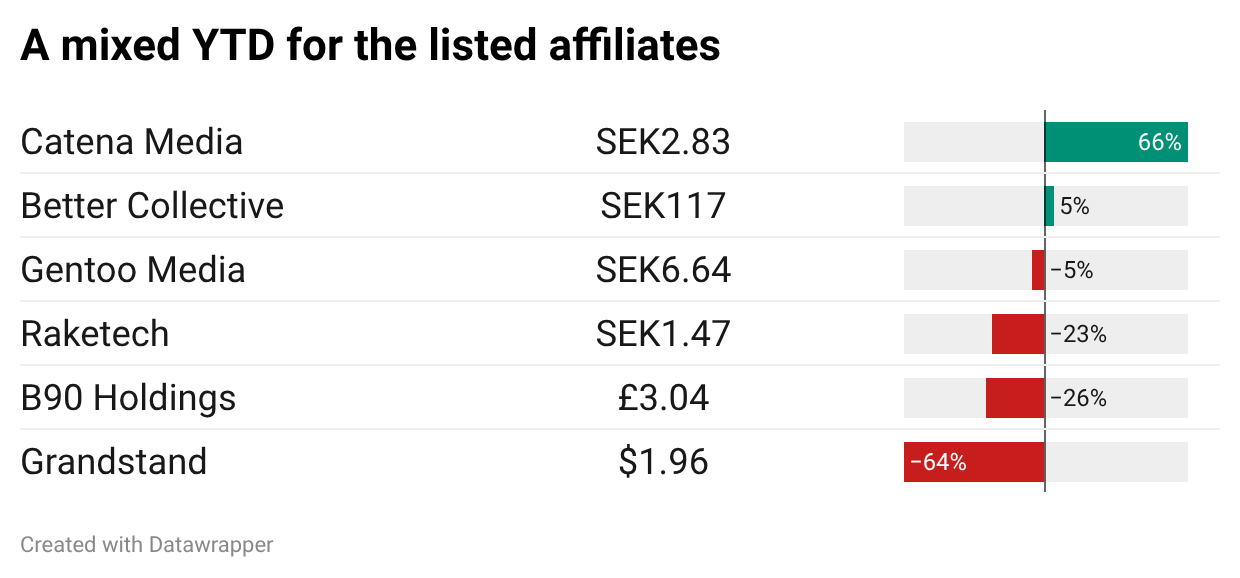
Search party: An opportunity might be developing with prediction markets but investors in betting and gaming affiliates remain largely unconvinced, appearing more concerned about the impact of AI on the sector, and search optimization in particular.
Taking the worst of the pain is Grandstand – formerly Gambling.com – which is down 64% YTD.
Offered a palette of a booming sports-data business, renewed strength in the North American affiliate business and somewhat disappointing UK and European performance, investors have chosen to focus on the bad news.
Similarly struggling to convince investors of its case is the UK-listed affiliate B90 Holdings, despite offering a positive H1 trading update in early August that said it expected revenue to exceed management expectations.
The company noted this was driven by strong core iCasino trading and continued optimization of its proprietary AI marketing platform.
CEO Ronny Breivik said the business was “thriving,” contrary to fears over the way that AI is “[reshaping] digital customer acquisition.”
Relief rally: Top of the rankings is Catena Media, which, having survived a near-death experience in the past couple of years, has seen its shares enjoy a renaissance off the back of managing to stabilize the now-wholly US-focused business.
The most recent news came on Friday after it launched a voluntary tender offer to repurchase its existing hybrid capital securities for cash at 20% of nominal value.
The move clears a further stock overhang

OpticOdds is now the first sportsbook API available inside Claude.
Your trading team can now query live odds, fixtures, player props, market data and more - all in a single sentence.
Setup takes two minutes. If you want to see it in action, get in touch at opticodds.com/contact
Scorecard
OSB in July: GGR across Deutsche Bank’s focal states rose 29% YoY for the month, reversing June’s 30.5% decline as operator-friendly World Cup results lifted hold to 11.5%. Handle increased 31.6%, although combined June-July GGR fell 4.5%. Post-tournament demand remained solid, with New York handle up approximately 11%. July GGR growth was led by BetMGM at 37%, followed by FanDuel at 27% and DraftKings at 26%.
Citizens said same-store OSB handle growth accelerated to 30% in July from 25% in June, despite fewer World Cup matches. More operator-friendly results lifted the industry gaming margin by 352bps MoM and 26bps YOY to 11.4%, largely reversing June’s weakness. DraftKings and Fanatics recorded the largest monthly GGR share gains after unfavorable sporting outcomes in June. Year on year, bet365, aided by state launches, and Fanatics continued taking industry share across the market.
Puts+takes
The fixer-upper strategy: Citizens argued Penn Entertainment’s most attractive growth opportunities may already sit inside its estate. Although external M&A remains possible, the operator is prioritizing the “low-hanging fruit” of replacing aging riverboats with modern land-based casinos.
The evidence is encouraging: trailing-12-month gaming revenue at Boyd Gaming’s replacement Treasure Chest property is 99% above the former boat, while Penn’s Joliet conversion is tracking 47% ahead of its predecessor.
Boomtown New Orleans is next. Penn plans to spend approximately $195m on a land-based casino opening in 2029, with Citizens expecting a return of at least 15%.
A planned cadence of one project annually should add EBITDAR without acquisition or integration risk.
Citizens forecasts 3% retail EBITDAR growth in 2027 and believes project spending will not derail deleveraging, with lease-adjusted leverage reaching approximately 5x by end-2027.
Entain’s H1 performance has left the analysts broadly positive, arguing that the current valuation fails to capture the company’s improving operations and longer-term cash generation. UBS described Entain as offering the greatest theoretical upside in European gaming, albeit with greater risk than peers.
Online growth is forecast at the top of Entain’s 5-7% guidance, while the team expects underlying EBITDA at the top of the £910m-£960m range.
Deutsche Bank highlighted the positive of H1 EBITDA 3% ahead of consensus, 13% UK online growth and Australia’s third consecutive quarter of market-share gains.
JPMorgan said that, while Entain CEE deconsolidation pushes forecast leverage to 3.6x, they expect this to fall to 2.9x by 2028 after the disposal is completed.
DraftKings: The CBRE team retained their Hold rating, citing encouraging volume growth alongside continued promotional and competitive pressure. Following Q2, the analysts increased their 2026 revenue forecast to $6.67bn from $6.50bn and adj. EBITDA estimate to $723m from $704m, broadly matching consensus and within unchanged company guidance. The team’s 2027 forecasts rose more substantially, with revenue now projected at $7.27bn and EBITDA at $1.06bn, partly reflecting prediction market contributions.
Upcoming earnings
Aug 26: GiG Software
Aug 27: Allwyn
Sep 10: Playtech

Grandstand (Nasdaq: GRSD) is the intelligence layer of sports, gaming and entertainment, building the brands consumers trust, the data partners act on, and the technology the industry runs on. Leveraging proprietary technology and a diverse portfolio of premium consumer brands, including Gambling.com, Casinos.com, OddsJam and OpticOdds, Grandstand connects operators to high-value players across global markets.
Positioned as the intelligence layer for sports, gaming and entertainment, Grandstand is an engine of growth and profitability, backed by a two-decade track record of driving results for partners across sportsbooks, casinos, fantasy platforms and beyond.
Visit our investor page to see why Grandstand is the platform behind the industry’s most successful operators.
An +More Media publication.
For sponsorship inquiries email scott@andmore.media.
