

Make it lower
DraftKings’ torpedoes own shares after guidance messaging SNAFU

CEO Jason Robins’ transparency on sandbagging backfires.
Earnings: Caesars and Rush Street lead the upcoming reports.
Rivalry on the verge of throwing in the towel.
Markets: Catena Media enjoys a good, but not brilliant, week.
Hard Rock Bet is growing – we know you know! And we want to bring in some more maestros to make beautiful music in our Sportsbook. You need to be among the very best in the industry to be considered for these roles. Are you up to it?
Torpedoed

Karma police, arrest this man: There is a version of DraftKings’ Q4 earnings call that goes well. The company beat EBITDA consensus by 28%, revenue grew 43% YoY and free cash flow hit $516m. By normal reckoning, it was a strong quarter.
And yet the shares dropped 13% on Friday and such was the pessimism it dragged rival Flutter Entertainment, home of FanDuel, down 11% in sympathy.
As Citizens noted, it brought DraftKings to a market cap of $10.8bn, below the recent $11bn valuation for privately held prediction markets operator Kalshi.
He talks in maths: The culprit for the adverse investor reaction wasn’t the Q4 earnings but the 2026 guidance, specifically a revenue outlook of $6.5bn-$6.9bn that landed roughly $600m below the Street’s $7.3bn consensus.
And the real problem wasn’t even the number itself. It was how CEO Jason Robins chose to explain it.
He buzzes like a fridge: On the earnings call, Robins was asked to walk through the building blocks of the 2026 revenue guide. What followed was one of the more remarkable pieces of executive candor.
Robins described his guidance-setting process in vivid terms: “It kind of went like this: my team came in and showed me a number and said, ‘We can hit this,’ and I said, ‘No, go make it lower.’”
“And they went back and they said, ‘Okay, now really like we’re sure we can hit this’. And I said, ‘I don’t care, make it lower again.’ And that’s what we got.”
He’s like a detuned radio: The intent was to signal conservative guidance that DraftKings could comfortably beat throughout 2026, and Robins explicitly invoked the 2023 playbook as his model.
“I look at 2023. At the beginning of 2023, we guided to what all of you thought was a disappointing number. We got killed. I think we were down like 16% on the day,” he said.
“And then we proceeded to beat and raise every quarter for the rest of the year, and got it back and then some.”
“That was a self-inflicted wound that we did that,” he added. “We ended up growing our adjusted EBITDA by $440m.”
But you’re still on the payroll: The tension was picked up on by the analyst community. Citizens said DraftKings was now a “show-me story,” while Deutsche Bank said the prudent approach would “have to be proven given the previous negative revision cycles.”
Bank of America went further, arguing the low guidance actually reinforced the bear case.
“While the guide is likely conservative, it’s also low enough to reinforce concerns on prediction market cannibalization,” the team said.
It’s not enough, I’ve given all I can: Compounding the damage, Robins also undermined his own guidance by revealing that prediction markets revenue, which he projected would generate “hundreds of millions” in annual revenue, contributes precisely zero to the 2026 outlook.
The fixed investment costs are in the guide, the revenue is not; creating an asymmetric framing where the guidance fully absorbed the costs of the company’s most exciting initiative but none of the benefits.
Citizens spotted this embedded upside, noting that DraftKings “clearly said on the call the cost structure is fully baked for ongoing investment with no revenue upside ascribed within the outlook.”
But the market wasn’t in the mood to give credit for optionality.
This is what you get: With prediction market uncertainty swirling, state tax proposals emerging from Arizona and Michigan, and January handle growth decelerating to just 4% YoY, investors had enough ambient anxiety to interpret the guide at face value rather than as a sandbagging exercise.
“It sounds to me like DraftKings has forgotten how public markets work and the importance of trust and credibility,” one investment source who opted for anonymity told E+M.
“But setting a low guide to beat and raise only works if that’s what you always do. You don’t get to chop and change.”
Truist said the sell-off was driven by “a confluence of the self-imposed ‘conservative’ guidance, prediction market uncertainty and fears of higher state taxes.”
The March 2 Virtual Investor Day now carries enormous weight.
E+M PRO – DraftKings’ Q4
Unpredictable: A $75m EBITDA beat couldn’t distract from a revenue guide that landed $600m below consensus and exposed differing opinions over whether prediction markets are a threat, an opportunity, or both.
See this morning’s Puts+Takes edition (PRO subscribers only).
The drop off: The tension between exceptional backward-looking execution and a below-consensus forward outlook will be played out in real time as investors digest the call.
See Friday’s Earnings Extra (PRO subs only).

Payment friction erodes confidence in your brand—costing you customer loyalty and lifetime value.
Build trust into every step with a better payment experience:
Increase confidence by offering seamless, familiar deposit methods
Boost retention with lightning-fast payouts that strengthen your brand
Limit payment outages with built-in processing redundancy
Reduce fraud and keep good players playing with AI-driven risk scoring
PayNearMe’s PayXMTM platform was built on the promise of Payment Experience Management—making payments easier for your customers and your team.
+More
Succession: Las Vegas Sands has appointed Patrick Dumont as its new chair and CEO, succeeding Robert Goldstein. Dumont, currently president and COO, will take over on March 1.
MLB commissioner Rob Manfred said the league is exploring partnerships with prediction market platforms, such as Kalshi and Polymarket. He told team owners that prediction markets could offer better monitoring tools amid recent betting-related scandals.
Deal talk
Max-ed out: Super Technologies, the operator of Superbet, has snapped up fellow Romanian operator Maxbet Online for an undisclosed sum. The Romanian Maxbet Online and its Maltese subsidiary are not to be confused with the Serbian-facing MaxBet, in which Flutter is a majority shareholder.
Data points
Handling it: Stifel said New York’s Super Bowl week data offered a reassuring read-through for online sportsbooks. Statewide handle rose 3% YoY, beating both Nevada’s decline and New York’s recent trend, despite an unappealing matchup and suggesting prediction markets have not yet dented demand. Kalshi’s notional volumes again outgrew sportsbooks WoW, but Stifel argued headline comparisons overstate share gains due to conversion assumptions, novelty markets and superior event liquidity.
The week ahead
Caesars Entertainment reports after the market closes on Tuesday (call 5pm ET). In the Earnings Preview, E+M said the message from the company was that Q4 should look materially better than Q3. How far that recovery has come, and whether it feels durable into 2026, will likely frame the conversation on this call.
On the same day, Rush Street Interactive also reports (call 6pm ET). In the Earnings Preview, E+M said that after a year of decent share price gains, the company can take comfort in the idea that investors now understand its story of iCasino strength allied to LatAm ambitions.
Also reporting this week, Hacksaw Gaming (Tuesday, 9.30am CET), Kambi (Wednesday, 9am CET), The Lottery Corporation (Wednesday, time TBC), FDJ United (Thursday, 8am CET) Raketech (Thursday, 8am CET) and Gaming and Leisure Properties (release Thursday; call Friday, 10am ET).
Rivalry’s troubles
Insert coin to continue: Four months after proudly declaring a third consecutive quarter of revenue growth and its structural turnaround complete, Rivalry has announced a “significant reduction in operating activity” and begun to evaluate strategic alternatives.
The operator is engaged in discussions with third parties regarding “potential transactions.”
Game over? The company has made almost all full-time employees redundant, effective immediately, per LinkedIn posts and an official release.
Rivalry is materially reducing the scale of operations, pausing player activity on the platform entirely but still facilitating player withdrawals in the ordinary course.
Engine rebuilt but out of runway: In early December, Rivalry’s Q325 results were posited as proof that its consistent tinkering and restructuring in the recent year had paid dividends. It showed revenue reaching C$1.93m ($1.41m), up 19% sequentially, operating expenses falling 58% YoY and with net loss narrowing by 67% to C$1.96m.
Management highlighted normalized run-rate costs and improving per-player economics, arguing the business was operating “increasingly closer to breakeven on a structural basis.”
I will go down with this ship: There is no line in a public filing as discouraging to read as “no assurance” that operations will continue in their current form.
From esports-only to a full-blown crypto-pivot, it looks like the operator has run out of space and areas to ‘innovate’ into.
From recapitalizing in October to declaring structural efficiency in December and effectively ceasing operations in February, it has certainly been an interesting journey to observe.
From glow-up to blow-up: Rivalry’s struggles are indicative of wider industry trends over the last decade, in which operators have overestimated the TAM of an esports-betting audience.
Rivalry looks set to claim its place in the elephant graveyard alongside the likes of Entain-acquired Unikrn and another botched crypto-experiment in Luckbox.

So my supervisor (Carl) suggested I “find alternative ways to contribute.”
I’m interpreting this as “grow the LinkedIn page or get decommissioned.”
Follow Octoplay at:
https://mt.linkedin.com/company/octoplay-op
Thanks,
Octobot
Markets
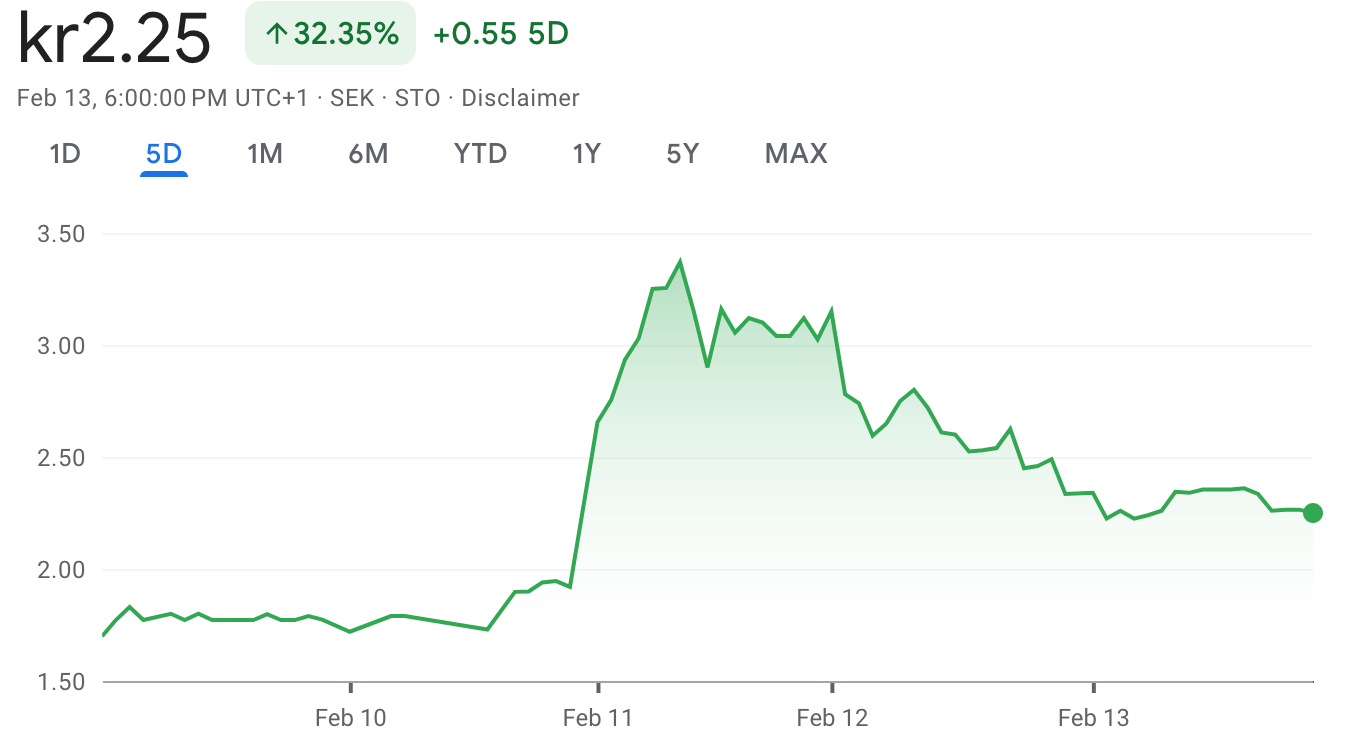
Surviving a near-death experience: The gaming affiliate Catena Media enjoyed an almost Lazarus-like revival this week, up 32% for the week after it reported its strongest quarterly performance since an organizational reset in 2024.
Q4 revenue rose 53% to €15.6m while adj. EBITDA substantially recovered to €4.7m, a 213% YoY improvement.
In the initial rush of enthusiasm the shares soared more than 80% on the day, before seeing those gains substantially pared back later in the week.
Moreover, zooming out it remains the case that Catena’s share price is a shadow of its former self.
At around SEK2.25 (25¢), it is more than 90% down from its peak in the summer of 2021 when a share was worth SEK75.
Living Legend: But for investors in the affiliate space, there is another data point that might be more relevant to the sudden enthusiasm for Catena Media.
Genius Sports’ acquisition of largely iCasino-led affiliate provider Legend for $1.2bn including earnout provided a boost to the sector.
More than the headline buyout price, it was the multiple of 8.5x that will have generated the most interest.
In a note last week on the prospects for Catena’s rival Better Collective, the analysts at Redeye said the deal for Legend “could improve sentiment in the online-sports-betting media and affiliation space.”
Catena Media’s (almost) great week
Puts+Takes – Wynn Resorts
Shine on: Wynn’s premium Las Vegas positioning continues to insulate it from broader Strip weakness, suggested the analysts following the company’s Q4 earnings last week. Seaport noted “the premium-end, dominated by Wynn, continues to show better resilience.”
This was echoed by CBRE, which observed that the premium offering “continues to shine” even as “softer leisure trends are significantly impacting value-oriented properties on the Strip.”
Table service: CBRE’s enthusiasm extends to Wynn’s Macau business where it believes the premium mass segment will continue to outperform. However, Seaport is more cautious, particularly on market share where it flagged that Wynn lost share to 12.1% vs. 13.1% in Q3.
The team warned that Wynn’s lower number of gaming tables relative to the prior concession period could limit upside from base mass recovery.
Marooned on an island: On the Wynn Al Marjan Island (WAMI) project, the analysts converged on the view that it’s meaningful but differed on precision. CBRE stood alone in beginning to model WAMI contribution in FY27 numbers, forecasting $71.5m of management fee EBITDA based on a ~50% revenue ramp to their stabilized estimate.
Deutsche Bank and Seaport kept WAMI out of their operating estimates, treating it purely as a valuation overlay.

We asked traders what they actually needed. Then we built it. OpticOdds Screen V2 gives you customizable layouts with MyView, real-time and historical odds side by side, and smart alerts that cut through the noise so you can act faster.
Get access NOW.
Upcoming earnings
Feb 17: Hacksaw Gaming, Caesars, Rush Street Interactive
Feb 18: Kambi, The Lottery Corporation
Feb 19: Gaming & Leisure Properties (earnings), FDJ United, Raketech
Feb 20: Gaming & Leisure Properties (call)

Venture capital firm Yolo Investments manages in excess of €500m in capital across 100 exciting fintech, gaming and blockchain companies. The Yolo Investments’ Gaming fund, regulated by the Guernsey Financial Services Commission, has taken positions in fast-growth suppliers and operators, including Dabble and Enteractive. Yolo Investments (yolo.io) wants to hear from readers of this newsletter. Get in touch with your pitch, or for a chat about innovative products which can plug into our investment ecosystem.
An +More Media publication.
For sponsorship inquiries email scott@andmore.media.
