


What does Wall Street want? Jason Robins’ frustration with institutional investors was evident last week when Front Office Sports asked why DraftKings’ shares were down around 50% this year. “That’s a great question for someone on Wall Street to answer,” he replied. His irritation is understandable: investors want DraftKings to counter the prediction-market threat decisively, but increasingly regard the investment required to do so as another risk. Some analysts want greater aggression; others fear cannibalization, rising acquisition costs and regulatory uncertainty. DraftKings is effectively being asked to demonstrate that it is investing enough and that it isn’t investing too much.
Hard Rock Bet is growing – we know you know! And we want to bring in some more maestros to make beautiful music in our Sportsbook. You need to be among the very best in the industry to be considered for these roles. Are you up to it?

Emotional weather report: The evidence presented last week by DraftKings would suggest the company is doing much of what investors might reasonably demand in response to the rise of prediction markets, which are “growing faster than we anticipated,” CEO Jason Robins told analysts.
More than 600,000 customers have engaged with the product YTD and annualized traded volume has risen nearly fivefold since April, from $2.3bn to $11bn.
Customer acquisition costs are “well below” Sportsbook CACs, while volume per customer and month-on-month retention look similar to Sportsbook.
Meanwhile, its Combos feature, the prediction-market equivalent of parlays, are already approaching 20% of consumer volume and have been used by more than half of DraftKings Predictions’ customers.
A chance of fog: There is also evidence of an urgency about DraftKings’ efforts – which arguably stands in contrast to what appears to be a less than frantic effort by rival Flutter – and a push towards building a vertically integrated offering.
It launched its DKeX exchange in June and received approval as a futures commission merchant in July.
In market making, DraftKings is active across three exchanges, operating profitably on singles and Combos.
Robins believes bringing exchange activity and market making in-house can capture economics currently flowing elsewhere while simultaneously giving DraftKings more control over product development.
Appetite suppressant: It all underpins Robins’ confidence that prediction markets are an opportunity rather than a threat. DraftKings says there is only around 1% customer overlap between its sportsbook and the largest prediction-market operator in legal OSB states.
Its analysis suggests 80-90% of prediction-market consumer volume in those states comes from professional syndicates and institutional traders.
Robins claims “very minimal, if any” cannibalization.
The full stack: Stifel thinks switching Predictions volume onto DKeX could roughly double the take rate on contracts traded through the DraftKings Super App. The team estimates volume reached ~$900m in July, albeit with taker-side volume representing only around 2.4% of Kalshi’s equivalent total.
But that was up from around 1.8% in May, hence the analysts’ argument that Predictions’ impact on the DraftKings valuation is being mispriced.
Citizens said it was getting “even more positive on prediction markets,” as DraftKings internalizes its technology stack. Its 2027 model assumes $630m of Predictions revenue, including $194m from the exchange and $266m from market making.
Truist is similarly constructive, seeing scope for DraftKings to outperform in the core business while producing “meaningful returns” from Predictions.
Gimme more: One of the more intriguing aspects of the debate is whether DraftKings should be spending more. The company expects Predictions to consume an incremental $200m-$300m in 2026.
But Stifel estimates Predictions’ customer-acquisition investment is still around 70-80% below what an equivalent OSB launch across the 16 relevant states would have required.
On the call, analysts repeatedly questioned Robins about pressing harder. Bank of America asked whether DraftKings would exceed $300m if acquisition economics remained attractive.
Oppenheimer queried whether 600,000 Predictions customers compared with the mid- to high-single-digit population penetration achieved in sportsbook launches.
Robins left the door open, leading Stifel to suggest that if “the fish are biting,” DraftKings will spend more.
Black box recording: But Robins also admitted DraftKings is taking “a little bit more of a cautious approach” than it would with an OSB state launch, partly because it is still working out ultimate prediction-market LTVs.
Stifel called the calculation a “black box,” pointing to uncertainty over how exchange fees and market-making spreads feed into the economics.
Let me ask my lawyer: More fundamentally, Robins acknowledged “regulatory questions” make the category’s future uncertain. “We aren’t leaning in quite as hard as we would in, say, a new state launch at this point,” he told the analysts.
The company sees efficient acquisition, encouraging retention, rapid volume growth and a path towards capturing brokerage, exchange and market-making economics.
Yet, it isn’t prepared to push as hard as those numbers alone might suggest because it cannot know with certainty what regulatory regime it will ultimately be operating within.
Tasty: The caution extends to the analysts. Deutsche Bank identified continued PM spending from “large, well-capitalized competitors” as a threat to both CAC and profitability as the NFL season approaches.
More significantly, it warned predictions might ultimately prove more cannibalistic to OSB, forcing DraftKings to spend more to defend its existing sportsbook customers.
Tearing me in two: Robins has some grounds for exasperation. Investors want DraftKings to respond decisively to the prediction-market threat but, when it does, the investment required is perceived as becoming another risk.
If it proceeds cautiously, the question becomes why it isn’t moving faster at the same time that the operating evidence is becoming more encouraging.
Go deeper with E+M PRO: Paid subscribers can read our full post-earnings work on DraftKings (below) and Flutter, including the analyst reaction, how prediction markets are changing the investment case for both companies and why the balance of power in US OSB could be shifting.


Increase Operator Margins with EDGE Boost Today!
EDGE Boost is the first dedicated bank account for bettors.
Increase Cash Access: On/Offline with $250k/day debit limits
No Integration or Costs: Compatible today with all operators via VISA debit rails
Incremental Non-Gaming Revenue: Up to 1% operator rebate on transactions
Lower Costs: Increase debit throughput to reduce costs against ACH/Wallets
Eliminate Chargebacks and Disputes
Eliminate Debit Declines
Built-in Responsible Gaming tools
To learn more, contact Matthew Cullen, chief strategy officer: Matthew@edgemarkets.io
+More
On hold: Bally’s has slowed construction of its permanent Chicago casino amid a dispute with City Hall over plans to allow video gambling terminals. The company said the move, described as “resetting the pace,” could affect up to 1,500 union workers. Bally’s argued that an uncontrolled proliferation of VGTs would breach the city’s commitment under its Host Community Agreement and has threatened legal action. However, it still expects the casino to open early next year and said it will honor its commitments.
Read across: Accel Entertainment expects Chicago’s first video gaming terminal locations to begin operating within weeks. In Compliance+More.
Earnings in brief
Poles apart: Century Casinos reported record Q2 revenue of $152m, up 1%, while adj. EBITDAR rose 5% to $31.7m. North America drove growth, with US West revenue rising 16% and adj. EBITDAR surging 93%. However, Poland weighed on results: revenue fell 19% to $19.9m and adj. EBITDAR dropped 97% to just $0.1m.
Deal talk
Tabcorp has agreed to acquire wagering technology provider BetMakers at an enterprise value of A$267m ($189m), saying the deal would accelerate the modernization of its wagering technology stack and strengthen its digital capabilities. Tabcorp shares rose 5.1% in Sydney following the announcement. Completion is expected in early 2027.
Planted a thought: Penn Entertainment CEO Jay Snowden suggested on the Q2 call that the company could be tempted by a Las Vegas strip asset, but only if the price was right. Clarifying that any M&A proposition would have to clear a “high bar,” he nevertheless suggested Penn’s largely regional customer base would “love [it] if we had a Las Vegas strip location.” But he immediately noted the caveat that any potential acquisition was “not any location, not any product.” “We’re certainly not interested in acquiring an asset that’s going to require another $400m-$700m capex investment because it’s got deferred maintenance,” he added. “It would have to check a lot of boxes. We’d love to be on the Las Vegas Strip at the right time, but it would have to be the right price, right asset.”
Puts+takes
Place in the sun: The good news for Full House Resorts is that it now has a clear pathway to completing a long-awaited financing package with which to go ahead with the construction of the permanent casino at American Place in Waukegan, Illinois.
According to the team at CBRE, after listening in to the Q2 call they believe Full House will soon finalize a package that will keep the all-in cost of the debt at under 10%.
Moreover, Full House also now has approval to continue operations at the current temporary structure through Feb29, “well beyond” the Q328 opening.
“It has now been three years since opening and the asset is still generating double-digit growth, highlighting the deep local market with plenty of unmet demand,” the team added.
Slow up: Less good news came from what Full House said about the Chamonix property in Colorado, which they said “continues to underperform and ramp much slower than expected.”
The company continues to adjust operations at the property, including a further management overhaul, a new outsourced marketing company and a new exec to focus on high-end customers.
“We are hopeful for continued progress toward profitability, especially in the seasonally stronger summer months,” said CBRE, before cautioning that they expect the ramp will “remain moderate.”
The week ahead
Cash is king: Entain’s H1 update must show that Q1’s encouraging volume growth is converting into earnings and cash.
Plus, Rank, Grandstand and Evoke also report.
See today’s Week Ahead edition, PRO subs only.

Octoplay has officially launched in Alberta on the first day of the province’s regulated iGaming market opening, going live simultaneously with BetMGM, FanDuel, DraftKings, Betty, Rush Street Interactive, PENN, and bet365. 🇨🇦
Markets
Swings and roundabouts: Jason Robins may find some sympathy for his unhappiness with how the markets have treated his shares among the C-suite at data, betting and media service providers Sportradar and Genius Sports.
Each has been hit this year by adverse market reactions: in the case of Sportradar to short-selling attacks, whereas with Genius Sports the Legend acquisition was the culprit.
However, this week, investors appeared to decide that both will be net beneficiaries from prediction markets, with Genius up 14% and Sportradar up 12%.
For Sportradar, the end of week figure masks the movement during the week where it was initially punished with a 17% drop when it reported on Monday.
Investors were spooked by a consensus miss and a nudging down of guidance.
There were also rumblings from the analysts about revenues from its deals with the leading prediction markets being delayed until 2027.
Yet, Sportradar regained the ground as the week progressed, partly helped by the positivity emanating from rival Genius, with major deals announced on consecutive days with Polymarket and Kalshi.
Investors also appeared to more clearly appreciate the company’s Legend acquisition, which helped the company to an EBITDA beat when it reported last Wednesday,
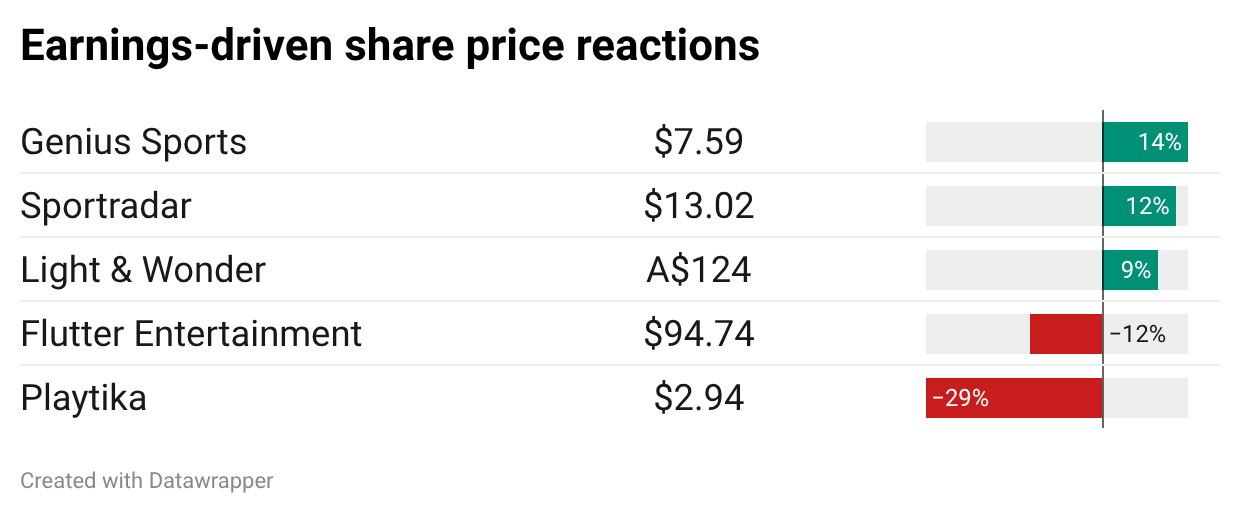
Appetite for destruction: There was no relief for Flutter Entertainment investors this week, down a further 12% after badly received Q2 earnings and the news that CEO Peter Jackson is to be replaced by president and head of international Dan Taylor.
In part, Jackson’s departure needs no further explanation than that the share price is now down more than 66% over the past year.
That leaves the company valued at just $16.4bn compared to more than $50bn last summer.
While the rock-bottom valuation might appeal to some investors, the analysts remain concerned that investors are being asked to take a number of issues on trust.
Playtika suffered a 29% collapse this week, with investors looking beyond the Q2 numbers and seeing a weaker H2 ahead. Revenue rose 5% YoY to $731.1m and adj. EBITDA increased 23.4% to $206.1m.
Disney Solitaire was the standout, with revenue up 289% YoY and 15.5% sequentially despite lower acquisition spending, while DTC revenue grew 63.1% to $287m. “Disney Solitaire has the potential to be one of the best games we have ever built,” said CEO Robert Antokol.
But the outlook exposed the trade-off behind those gains. Playtika retained its FY26 ranges but expects revenue and EBITDA towards the lower end.
The company also detected an industry slowdown from mid-quarter, which CFO Tae Lee attributed to “weakening consumer confidence.”
Meanwhile, Bingo Blitz revenue fell 9.5%, daily active users declined 9.1% and paying users dropped 2.9%.
Upcoming earnings
Aug 11: Catena Media, DoubleDown Interactive, High Roller
Aug 12: Evoke
Aug 13: Entain, Grandstand, Rank, Bragg

OpticOdds is now the first sportsbook API available inside Claude.
Your trading team can now query live odds, fixtures, player props, market data and more - all in a single sentence.
Setup takes two minutes. If you want to see it in action, get in touch at opticodds.com/contact
An +More Media publication.
For sponsorship inquiries email scott@andmore.media.
